
THE KARMIC THREAD
What Happens Between the Seed and the Act?


श्रोत्रस्य श्रोत्रं मनसो मनो यद् वाचो ह वाचं स उ प्राणस्य प्राणः । चक्षुषश्चक्षुरतिमुच्य धीराः प्रेत्यास्माल्लोकादमृता भवन्ति ॥
“That which is the ear of the ear, the mind of the mind, the speech of speech, the life of life, and the eye of the eye, by knowing That, the wise transcend this world and become immortal.”
~ Kena Upaniṣad (1.2)
Thoughts appear, and almost immediately feelings gather around them, giving them weight. A desire takes form somewhere beyond the reach of our conscious mind, and when it surfaces, it seems to know exactly what it wants. Intention takes shape, and then the hands move or the words are uttered. Even silence can become a kind of action. It is only much later that we turn back and sense that something had already been moving in us before we moved.
What was alive in me before I acted?
This question isn’t just about philosophy. It belongs to anyone who has ever spoken a word they later wished they could take back, and wondered where it came from. This movement continues to return and to our frustration we discover that understanding a pattern is not the same as the release from its hold on us.
The deed may be long past, but whatever gave rise to it can linger, quietly shaping the next moment before it arrives.
We usually think about karma in terms of the act itself. You act, and consequences follow. That is where most of us begin. And that also leads us to accept the commonly held belief in an invisible ledger of deeds, governed by “As you sow, so you reap”. When we honestly look at the single lived moment of the act, words that were spoken in haste or impatience. A generosity that surprised us, a silence we still regret or even that silence we still carry. It becomes clear that the visible act is only the last expression of a movement that began much earlier and mostly in silence. We feel it before we understand it.
Karma, when observed closely, is the trajectory of our inner life that becomes visible. And the outer life is nothing more than a shadow of the inner posture.
This naturally leads us to a deeper inquiry. Where does intention come from? Not simply from the thought or the moment of choosing.
More importantly, what shapes our choosing before we become conscious of it?
So, let’s dive deeper.
The Hidden Roots
Let us look at a common occurrence, two people are part of a situation and both face the same provocation. One responds with patience, the other with sudden anger, even though it’s the same event, but the outcomes couldn’t be more different. That is to say we don’t always respond to the same situation in the same way. This happens because each of us meets the outer world from our uniquely conditioned inner space, that was shaped by years of experiences. And our beliefs about right and wrong. That which was building the ground within the space from which the deed rises and not from the moment of the act.
Like the river flowing and cutting channels into the earth, which once formed, guide the flow to its destination. The river does not choose different paths it simply follows the carved grooves, unless obstructed. Human mind pretty much works on the same principle, repeated conditioning, thoughts, or feelings, create conditions for repeated action, unless awareness helps it to act differently.
Vedanta gives these inner channels a name: impressions (saṃskāra), layers of subtle residues built over time of lived experiences. And latent tendencies (vāsanā) arise from that, some move us towards certain desires and others moves us away from certain other desires. Often happening without we having the chance to question them. The words are simply names for something we may already recognise within ourselves. Together saṃskāra and vāsanā form a hidden root system beneath the soil of conscious choice. And when we say, “I decided,” we do not see that decision watered by these hidden currents. So, before we choose, something may already be inclining us.
If intention has roots, so does desire.
स यथाकामो भवति तत्क्रतुर् भवति । यत्क्रतुर् भवति तत्कर्म कुरुते । यत्कर्म कुरुते तदभिसंपद्यते ॥
“As is one’s desire, so is one’s intention. As is one’s intention, so is one’s action. As is one’s action, so is one’s destiny.”
~ Bṛhadāraṇyaka Upanishad (4.4.5)
Desire is not the first cause, from the samskāric field it rises. The intention follows, then comes the action and from this action the entire direction of life is shaped.
So, the idea of “my choice” carries a history and weight of what came before it, this recognition can be very unsettling. But it doesn’t mean we lack freedom; it means the freedom we exercise is dependent on conditions shaped all through our lives and something we didn’t create or rarely see.
The Fire and the Momentum
In another scenario, due to old resentments the anger rises. We feel the familiar heat gather within our chest, and there is a surge of reactive impulses that may feel irresistible. But on this occasion, you decide not to speak and your hands stay still. Does that mean the fire within has gone out?
Not necessarily.
What has happened is significant. The outward movement was interrupted. Impulse rose, intention began to form, but the action did not follow. The world was not struck by what might have been. And in that pause, something became visible that might otherwise have remained hidden.
But restraint (dama) is not transformation. The fire may still be burning.
Our conditioning and identifications remain untouched. They have not gone anywhere. They are still here, still waiting, still capable of rising. Outer restraint (dama), the holding back of the senses and the outward movement, can prevent harm. Inner quietening (śama) gradually settles the mind itself, slowly changing the inner space from which harm arises. Both have their place, but they are not the same. It is a special kind of discipline where one can exercise restraint on impulsive action without violently suppressing it, even as one sees and feels the fire within rise clearly. And yet, the inner quietening (śama) goes further, turning inward to inquire and find what is still hidden within the darker crevices of our mind.
Even when the act is restrained, the mind may continue to move. The imagined conversations still unfold. Vedanta calls this momentum prārabdha, that portion of karma already set in motion. The fan has been switched off, yet the blades spin on. The momentum does not vanish simply because we have seen it for what it is. Yet the movement is no longer quite the same. The fire is no longer being fed in the dark.
Yet even this seeing does not produce instant stillness. A pattern may be recognised, and still the old movement continues. The irritation and defensiveness still stir. The one who has begun to see may ask, with some frustration: Why am I still like this? I thought I had seen it.
But something can shift, almost imperceptibly.
The one who watches the spinning is no longer entirely convinced that they are the blades. The movement continues, but the sense of ownership has begun to thin. And now a question surfaces, almost of its own accord. Who is the one that has been watching all along? Who is the one that claims the action as ‘mine’?
प्रकृतेः क्रियमाणानि गुणैः कर्माणि सर्वशः । अहङ्कारविमूढात्मा कर्ताहमिति मन्यते ॥
All actions are performed by the fundamental forces of nature (the guṇas of prakṛti). The one whose understanding is deluded by ego thinks, “I am the doer.”
~ Bhagavad Gita (3.27)
This light does not arrive from somewhere else. It is what has been here all along, closer than the breath.
That sense of being a separate doer, doership (kartṛtva), is itself something that arises. It can be noticed. And what can be noticed cannot be the final seer. Even the one who watches can be noticed. The one who is trying so hard to be free, who is practicing awareness, can quietly become a new identity, the spiritual doer who feels, I am making progress. But the light in which even that appears has never been an identity at all.
What Was Never Bound
The karmic thread can be traced through the body, through the mind, through every impression and tendency we have accumulated. It moves through desire, through intention, through action, through the one who claims the action, through the one who seeks to be free of it.
But the thread was never around the Self (Ātman).
It belongs to the realm of becoming, the world of time, of cause and consequence, of movement. The Self does not become. The thread moves. What we most truly are does not.
At the level of ordinary life, karma remains deeply real. Action matters, so does harm. Responsibility remains. It is not touched by the glimpse of something deeper. But the inquiry does not point away from life. The inquiry leads us back into the life we are already living, with a little more space to see what is actually there. So that which struggles or suffers is not who we are as a whole. There is something else, more still than stillness, that watches the struggle (sākṣin) without being pulled into it. All along present and noticing, without getting entangled with the movement of the thread.
आत्मा वा अरे द्रष्टव्यः श्रोतव्यो मन्तव्यो निदिध्यासितव्यः ।
“The Self, my dear, is to be seen, to be heard about, reflected upon, and contemplated.”
~ Bṛhadāraṇyaka Upanishad (4.5.15)
This is where we can clearly understand that through all the movements something remains unchanged.
The one who searches is, in the end, the sought.
The Hand Still Moves
Tomorrow, the mind will still think. Words will still rise. Life will continue to throw up situations and choices. The old reactions may surface; they haven’t simply vanished. Something within us has changed and we are aware of the old patterns. Now there is a pause between the impulse and the deed.
The question may no longer be, How do I control my karma? It may have turned inward. Toward the one who watches and the one who claims. The inquiry does not end, it simply becomes the way of life.
पूर्णमदः पूर्णमिदम्
“That is whole. This is whole.”
PS
These essays arise from the same contemplative practice that shapes the way I accompany people through the questions and challenges of ordinary life.
My work is rooted in the wisdom of Vedanta, not as philosophy to be admired, but as something to be lived, quietly and practically, in the midst of relationships, work, loss, uncertainty, and everyday living. What is explored on the pages finds its fuller expression in the way we eventually meet our own everyday life.
That is why I sit with a small number of individuals in a more direct and personal way. Right now, that work has taken the shape of a special initiative for those who feel the weight of crushing loneliness, affecting their every other aspect of daily life. And it begins to shape how we see ourselves, how we work, how we love, and how we withdraw.
If you are drawn to explore and feel ready to move, you’re welcome to reach out. I always respond personally. And when the intention feels aligned and the time is available, we can start.
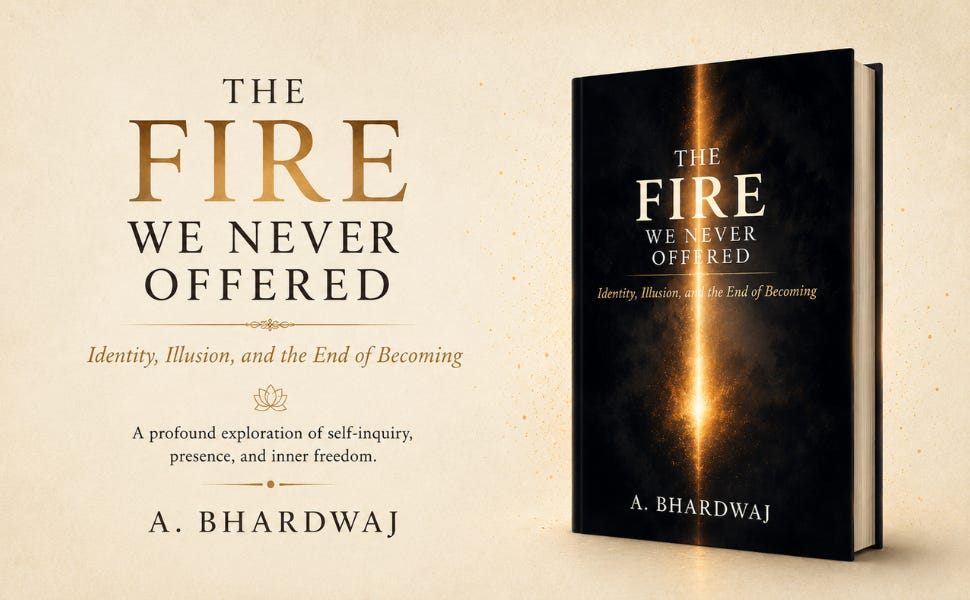
And also, My Book:
There are moments when something does not feel new, but remembered. Not discovered, but uncovered. It is an invitation, to pause, to look again.
Follow the desired link:
Amazon.com:
https://a.co/d/01hw3VAI
Kindle:
https://a.co/d/0b8M3z8p
Barns & Noble:
https://www.barnesandnoble.com/w/the-fire-we-never-offered-a-bhardwaj/1150825170?ean=9789392546488
Amazon (India): https://amzn.in/d/06SNcTaf
Kindle (India): https://amzn.in/d/01b0XNwI
Every time I read your essays, I feel less like I'm being taught and more like I'm being invited into contemplation.
That is such a rare quality.
"The one who searches is, in the end, the sought."
Thank you for sharing your wisdom with such humility. 🫶
I appreciated the way you moved the focus from actions to the quiet movements that come before them. It reminded me that understanding often begins long before change becomes visible. Thank you for this thoughtful reflection.